
Exhibition Completion returns Opus X to Boston
The response to PianoArc’s latest instrument at the Metropolitan Museum of Art’s Musical Bodies exhibition has been an extraordinary affirmation of what can happen when musical innovation, distinctive design, and a fundamentally new approach to the keyboard come together. Throughout its time at the Met, PianoArc’s latest creation, dubbed Opus X in recognition of being the tenth instrument produced, accomplished something few musical instruments can claim: it stopped visitors in their tracks, captured their imagination, and challenged them to rethink what a keyboard instrument can be.

As part of an exhibition exploring the relationship between music, the human body, and the objects through which we experience and create music, PianoArc proved to be a natural conversation starter. Its distinctive circular configuration immediately set it apart from the instruments and objects surrounding it. Visitors were drawn not simply to the visual novelty of the instrument, but to the performance ideas it might inspire and the sonic possibilities it represents.
A Different Way to Think About the Keyboard
For generations, the conventional piano keyboard has remained remarkably consistent in its basic geometry. PianoArc interrupts that tradition. By arranging 288 notes in a circular format, it offers a fundamentally different physical and conceptual relationship between the player and the instrument. Rather than navigating a linear arrangement of keys, players encounter a continuous, spatially organized musical environment that invites exploration and experimentation.
This departure from convention was particularly compelling in the context of Musical Bodies. The exhibition examines how instruments shape our physical relationship with music, and PianoArc makes that relationship impossible to overlook. Its circular design changes the way players approach movement, orientation, reach, and musical organization.
The reactions from exhibition visitors reflected the breadth of its appeal. Musicians were interested in its unconventional layout and the possibilities it might offer given its incredible range. Designers and artists were drawn to its sculptural qualities and the challenge it presents to established ideas about instrument design. Others were simply intrigued by the question of how such an instrument works and what it might feel like to play.
That diversity of interest was perhaps one of PianoArc’s greatest successes at the exhibition. It appealed to people well beyond the traditional keyboard community, engaging visitors who approached it from entirely different creative and intellectual perspectives.
The Next Chapter: Bringing PianoArc Back to the Public
With the conclusion of its time at the Metropolitan Museum of Art, PianoArc has returned to Boston, where it will once again be available for closer, more personal engagement.
The experience at the Met demonstrated the value of SEEING the PianoArc in person. Photographs and descriptions can communicate its overall appearance, but they cannot fully convey the physical experience of PLAYING it, exploring its circular arrangement, and understanding the possibilities of its design. For those who have followed PianoArc’s development or discovered it through the exhibition, the opportunity to experience the instrument firsthand is an important next step.
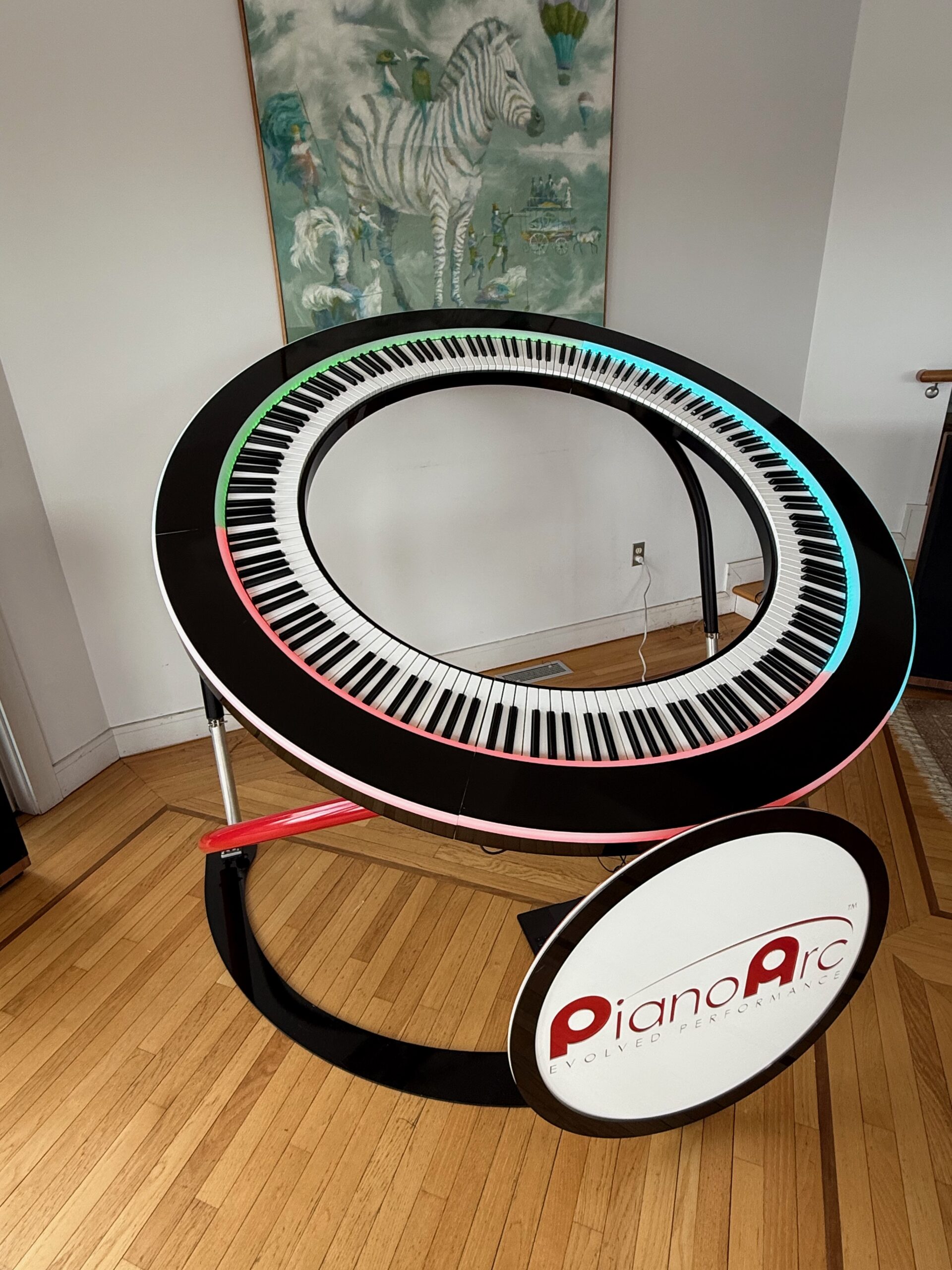
With its return to Boston, PianoArc is now available for in-person trials and demonstrations, as well as selected engagements at approved events where PianoArc personnel are in attendance. These opportunities will allow musicians, prospective owners, designers, institutions, and other interested parties to spend time with the instrument, explore its distinctive configuration, and better understand its potential.
Because PianoArc is a highly specialized and individually produced instrument, these engagements will be arranged selectively. The intention is to provide meaningful opportunities for interaction in settings where the instrument can be properly presented and experienced, with knowledgeable PianoArc personnel available to introduce its features and answer questions.
Individuals and organizations interested in arranging a private trial, exploring a potential acquisition, or considering PianoArc for an approved event are encouraged to make an inquiry directly.
An Idea That Continues to Move Forward
PianoArc has always been about more than creating another keyboard. It is about expanding the possibilities of musical interaction while exploring the intersection of instrument design, sculpture, and individual expression.
Its time at the Met reinforced that ambition and introduced the PianoArc concept to an important new audience. Now, back in Boston, the opportunity shifts from observation to participation. For those who were captivated by it at the exhibition, and for those just discovering it, the next opportunity is to experience PianoArc for themselves.


